 comparison
Chemical Peels vs Facials for Acne: Which Works?
Table of Contents
- Chemical Peels vs Facials for Acne: What's the Difference?
- Quick Comparison: Chemical Peels vs Facials for Acne
- Benefits of Chemical Peels for Acne
- What a Corrective Facial Can Do for Acne-Prone Skin
- How Often to Get Facials for Acne vs. Peels
- Choosing Between a Chemical Peel and a Facial for Your Skin
- Conclusion
- Frequently Asked Questions
Last Updated: September 9, 2026
Chemical Peels vs Facials for Acne: What's the Difference?
A chemical peel applies an acid solution to dissolve bonds between dead skin cells, triggering controlled exfoliation. A facial is a multi-step treatment including cleansing, steam, extraction, massage, and masks. When comparing chemical peels vs facials for acne, the core distinction is chemistry versus manual care: peels penetrate the epidermis chemically, while facials use cleansing and physical techniques for pore congestion.
These treatments target acne through different mechanisms. Peels use AHAs or BHAs to loosen the "glue" holding dead cells together (keratolysis). Facials rely on manual extraction and soothing ingredients.
The right choice depends on your acne type, sensitivity, and downtime tolerance. Below, we break down how each works and what results to expect.
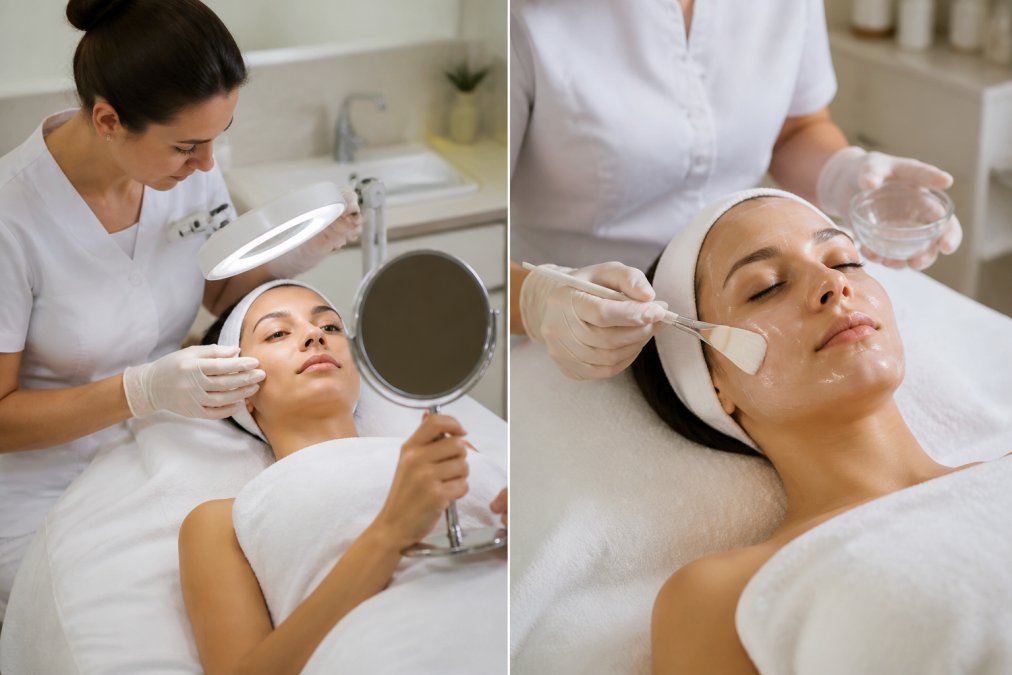
Quick Comparison: Chemical Peels vs Facials for Acne
Chemical peels apply acid to resurface the skin, while corrective facials are personalized sessions combining analysis, cleansing, and targeted ingredients.
| Factor | Chemical Peel | Corrective Facial |
|---|---|---|
| Primary Action | Chemical exfoliation | Cleansing, extraction, masks |
| Best For | Acne scarring, texture, hyperpigmentation | Active breakouts, congestion, skin health |
| Downtime | Varies, can include peeling | Minimal to none |
| Frequency | Every 2-6 weeks | Every 3-4 weeks |
| Customization | Acid type and strength | Tailored to your skin analysis |
| Skin Barrier Impact | Can be irritating if overdone | Generally supportive |
A peel is a resurfacing event; a facial is a maintenance session that supports the barrier while addressing congestion. Both aid breakout prevention at different skin levels.
Benefits of Chemical Peels for Acne
Chemical peels offer a targeted approach that penetrates the pilosebaceous unit, the hair follicle and sebaceous gland, the epicenter of acne formation.
How Specific Acids Work on Acne
Different acids target different aspects of the acne cascade:
- Salicylic Acid (BHA): As a beta-hydroxy acid, it is lipid-soluble, meaning it can dissolve in oil. This allows it to penetrate through the sebum that clogs pores and exfoliate inside the follicle. It is also anti-inflammatory, making it particularly effective for red, inflamed papules and pustules. In professional peels, concentrations typically range from 20% to 30% (peer-reviewed research).
- Glycolic Acid (AHA): This alpha-hydroxy acid is smaller in molecular size, allowing for rapid penetration into the epidermis. It works by breaking the desmosomes, the intercellular 'glue', that hold dead skin cells together. This action helps to smooth rough texture and prevent the buildup of dead cells that can trap sebum and lead to comedones. Professional concentrations often start at 30% and can go up to 70% for deeper resurfacing (peer-reviewed research).
- Mandelic Acid (AHA): With a larger molecular weight than glycolic acid, mandelic acid penetrates more slowly. This makes it an excellent option for those with sensitive or darker skin tones (Fitzpatrick types IV-VI) who are at higher risk for post-inflammatory hyperpigmentation (PIH). It provides the exfoliating benefits of an AHA with a much lower risk of irritation.
- Jessner's Solution: A combination peel typically containing salicylic acid, lactic acid, and resorcinol. It is a classic superficial-to-medium depth peel that is highly effective for comedonal acne and oily skin, working synergistically to dissolve blockages and exfoliate the surface.
Targeting Acne Scarring and Hyperpigmentation
For post-acne concerns, peels are often the most direct intervention short of laser therapy. By inducing controlled injury, peels stimulate fibroblast activity and collagen remodeling, softening atrophic scars and fading red or brown macules. A series of 4-6 superficial peels spaced 2-4 weeks apart is standard (the American Academy of Dermatology).
The Role of Concentration and pH
Peel efficacy depends on acid type, concentration, and pH. A lower pH means a more aggressive peel; professional peels are formulated for controlled depth. At-home products are buffered to a higher pH and cannot achieve the same results. A professional assesses tolerance and selects acid and strength to minimize risks like burns or dyspigmentation.
The trade-off is downtime and increased photosensitivity. Daily broad-spectrum sunscreen is non-negotiable for at least one month post-treatment.
What a Corrective Facial Can Do for Acne-Prone Skin
A corrective facial is not a standard "spa facial." It begins with a thorough skin analysis of congestion, reactivity, and barrier needs. At SKIN SOLUTIONS BY 2 DIVAS, every plan is built around your unique profile, not a one-size-fits-all menu.
The facial combines gentle exfoliation, manual extraction, and targeted masks or serums. For sensitive skin, this is often safer than a peel, as the esthetician can adjust in real time.
Facials address barrier health, which peels cannot. A compromised barrier causes water loss, irritation, and worse breakouts. Regular facials maintain the barrier while treating acne, which is why many routines include monthly facials. Results are cumulative.
How Often to Get Facials for Acne vs. Peels
Facials for acne are commonly done every three to four weeks, matching your skin's natural cell turnover cycle, allowing recovery without over-treating.
Peels are typically spaced two to six weeks apart depending on acid strength. A superficial peel can be repeated more often; a deeper peel needs longer intervals. If your skin feels tight, flaky, or sensitive, you are not ready for another treatment.
Book your appointment today! →
For persistent acne, some recommend a closer series, then maintenance.
Choosing Between a Chemical Peel and a Facial for Your Skin
Choosing between a peel and a facial is a strategic decision based on your skin's state, acne type, and long-term budget. The critical question is the long-term return on investment for your condition.
The Cost-Benefit Analysis Over Time
For chronic acne, the real cost is cumulative.
Using 'If-Then' Logic for Your Decision
To simplify the choice, apply this clinical logic:
- If you have active, painful, cystic lesions, then a chemical peel is contraindicated. The acid can exacerbate inflammation and spread the infection. A soothing, anti-inflammatory facial with gentle extractions is the safer first step.
- If your skin is resilient and your primary issue is post-inflammatory hyperpigmentation (brown spots) or shallow rolling scars from past breakouts, then a series of chemical peels will deliver faster, more visible results than facials alone.
- If you are prone to sensitivity, rosacea, or have a compromised skin barrier (characterized by stinging, tightness, and flakiness), then you must repair the barrier before any peel. Start with a hydrating, barrier-supporting facial and a strict home care regimen.
- If you are preparing for a major event in 2 weeks, then a light, superficial peel (like a 20% salicylic acid or a low-strength lactic acid) can provide an immediate 'glow' and smooth texture with minimal downtime, whereas a deeper peel would be too risky.
Managing the 'Purge' Phase vs. The 'Glow'
A facial provides an immediate but temporary 'glow.' A peel targeting deeper congestion often triggers a 'purge' phase 3-7 days post-treatment, as accelerated cell turnover pushes microcomedones to the surface. This looks like a flare-up but is not failure, it means the treatment is working. Understanding this prevents patients from abandoning a beneficial plan.
Before committing to a 6-month plan, ask for a detailed treatment calendar and cost breakdown. A reputable clinic will address both immediate breakouts and long-term health, not just sell a single service.
Conclusion
Choosing between chemical peels vs facials for acne is about matching the treatment to your skin's state and goals. Peels resurface scars and pigmentation; facials provide barrier support for active breakouts. The most effective path for most is a combination sequenced by a professional.
At SKIN SOLUTIONS BY 2 DIVAS, we start with a thorough skin analysis. Whether your concern is hormonal acne, hyperpigmentation, or event prep, our custom corrective facials are designed around your needs and sensitivity. We use high-quality ingredients and will tell you honestly whether a peel, facial, or combination is right.
Book your appointment today and let us build a treatment plan that actually fits your skin.
Frequently Asked Questions
Can a chemical peel help with facial acne?
Yes. Chemical peels exfoliate the top layers of skin, which helps unclog pores and reduce inflammation. Salicylic acid peels are especially effective for acne because they penetrate oil-filled pores. A series of peels is often needed. For mild acne, a superficial peel may be enough. For deeper cystic acne, a dermatologist-recommended peel might be a better fit. Your skin type and acne severity determine the right peel strength and schedule.
Should I get a facial or chemical peel first?
Start with a professional facial. A facial includes a thorough skin analysis, allowing an esthetician to assess your skin type, acne severity, and any sensitivity. This assessment guides the correct treatment, which may include a chemical peel. Jumping straight to a peel without this evaluation raises the risk of irritation.
How many chemical peel sessions do I need for acne?
Most people need a series of 3 to 6 treatments, spaced 2 to 4 weeks apart, to see significant improvement. The number depends on your acne type and how deep the peel penetrates. Superficial peels require more sessions than medium-depth peels. After the initial series, maintenance peels every few months help prevent breakouts. An esthetician will track your progress and adjust the plan based on your skin's response.
What is the expected downtime for a chemical peel versus a standard facial?
A standard facial has almost no downtime; you might see mild redness for a few hours. Light chemical peels cause light flaking for 2 to 3 days. Stronger peels, like those using TCA, can cause noticeable peeling for up to a week. Your skin barrier needs time to repair. Plan your schedule around the peel strength. Always follow post-treatment instructions from your esthetician.
Can I use at-home chemical peels instead of professional treatments for acne?
At-home peels are much weaker than professional-grade options. Products with 2% salicylic acid, like Paula's Choice BHA, are good for daily maintenance. However, they don't penetrate as deeply as in-office peels, so they are less effective for stubborn or cystic acne. For moderate to severe acne, professional peels offer stronger concentrations and expert monitoring. Using both can work: at-home products maintain results between professional visits.