 ultimate-guide
7 Reasons Regular Full Body Skin Checks Matter
Last Updated: October 31, 2026
Quick Summary
Regular full body skin checks support early detection of skin cancer, which is generally easier to treat when caught early. A check examines the entire skin surface, from scalp to soles, for new or changing moles and spots. Most adults are advised to pair a yearly professional check with monthly self-exams at home.
- A full body skin check is a visual exam covering the scalp, face, and entire body down to the soles of the feet.
- Dermatology guidance commonly advises examining your skin head to toe every month.
- Keep monthly photos taken at the same time and lighting so changes are easier to compare over time.
- Use the ABCDE rule to spot asymmetry, irregular borders, uneven color, diameter over about 6 millimeters, or evolving features.
- The evidence on routine screening of people without symptoms is mixed, and false alarms can lead to unnecessary biopsies.
Table of Contents
- What a Full Body Skin Check Involves
- Why Regular Skin Checks Support Early Detection
- What Happens During a Skin Cancer Screening
- Skin Cancer Warning Signs to Watch For
- How Often to Get a Skin Check
- What the Evidence Does and Does Not Show
- Scheduling Your Next Skin Check in Sebring
- Frequently Asked Questions
Skin cancer is most treatable when it is caught early, and regular full body skin checks are one of the simplest ways to catch it. At Skin Solutions by 2 Divas in Sebring, FL, we focus on custom corrective facials tailored to your skin concerns. Regular full body skin checks are one of the simplest ways to support early detection, so paying closer attention to the skin you live in is worthwhile.
Below, we walk through seven reasons regular full body skin checks matter, what the exam involves, and what the evidence does and does not show. Keep reading for a clear picture of when to get checked and what to watch for in between.
What a Full Body Skin Check Involves
A full body skin check is a visual examination of the entire skin surface, from the scalp and face down to the soles of the feet. The examiner looks for moles, spots, or patches that are new, changing, or unusual in shape, color, or size. A dermatological guide for primary care physicians describes regular full-body skin checks as a way for clinicians to detect potential premalignant lesions and skin cancers.
The exam is generally quick, though a dermatologist may use a handheld magnifier called a dermatoscope for closer inspection. Areas that are easy to miss, such as the scalp, between the toes, and the backs of the knees, are part of a thorough check.
Why Regular Skin Checks Support Early Detection
Early detection is the main reason to keep up with skin checks. Skin cancers caught at an early stage are generally easier to treat than those found after they have grown or spread. Regular checks create a baseline, so a change in a mole or spot is easier to notice and easier to evaluate.
Self-monitoring also matters between professional visits. Dermatology guidance commonly advises examining your skin head to toe every month. Keep a simple record, such as photos taken at the same time each month, so you can compare changes over time.
What Happens During a Skin Cancer Screening
A professional screening is generally a structured visual exam, and knowing the sequence makes the visit less stressful. Screening providers typically ask about personal and family history of skin cancer, sun exposure, and any spots that concern you, then examine the skin systematically from the scalp down to the soles. A handheld magnifier called a dermatoscope is often used to look at a mole's pigment pattern and blood vessels more closely.
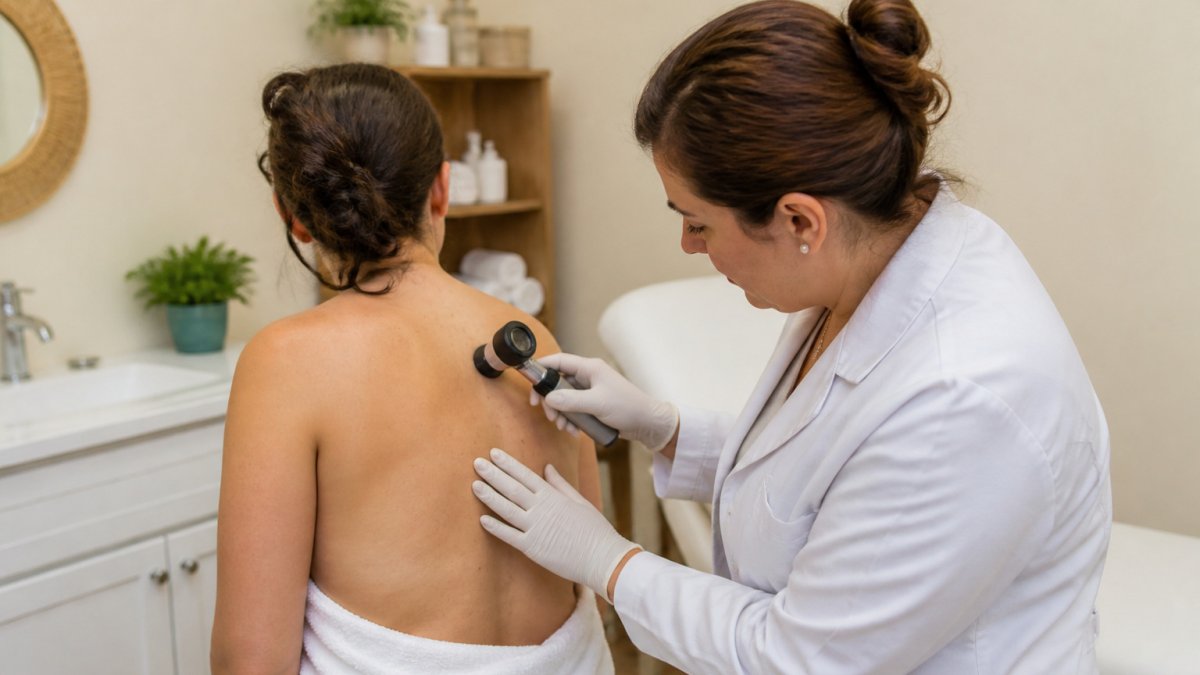
What gets flagged. The provider is looking for new, changing, or unusual lesions, and for the ABCDE features of melanoma: asymmetry, irregular border, uneven color, diameter greater than about 6 millimeters, and evolution over time. They are also checking for basal cell and squamous cell carcinomas, which can look pearly, waxy, scaly, or like a sore that does not heal, and for actinic keratoses, rough precancerous patches common on sun-exposed skin. Sun damage, including freckling and lentigines, is noted as part of the overall picture.
The follow-up pathway. When something looks suspicious, the next step is generally a biopsy, which removes a small sample of tissue for lab analysis, so a suspicious finding leads to testing rather than an immediate conclusion.
The downsides worth naming. Screening is not free of trade-offs, and false positives can lead to biopsies that turn out benign. These are legitimate reasons to talk with your provider about what a finding would mean before it happens.
Individualized care. A screening can account for factors such as skin tone, age, immune status, and prior skin cancer. Tell your provider about any prior skin cancer, transplant, or immunosuppressive medication so the exam is tailored to you.
Keeping a record between visits. A consistent photo record and a short written log of when a spot appeared or changed can make the next visit more productive.
Skin Cancer Warning Signs to Watch For
The ABCDE rule is commonly taught as a memory aid: Asymmetry, irregular Border, uneven Color, Diameter greater than about 6 millimeters, and Evolving size, shape, or color. A spot that changes over time deserves attention even if it does not match every letter. Our guide on when a new mole warrants a closer look explains which changes are worth a professional evaluation.
Other warning signs include a sore that does not heal, a spot that bleeds or itches persistently, or a new growth that looks pearly, waxy, or scaly. Any of these is worth a professional look.
Book your appointment today! →
How Often to Get a Skin Check
There is no single schedule that fits everyone, and any honest answer has to start with risk. A common approach is to sort people into rough risk tiers and set an interval from there, then adjust as history changes.
Average risk. Adults with no personal or family history of skin cancer, no unusual moles, and no significant sun or tanning-bed exposure are often advised to have a professional check roughly once a year, paired with a monthly self-exam at home. Some providers suggest every one to two years for younger adults with low risk, while others prefer annual visits so a baseline is established and changes are easier to spot.
Elevated risk. People with any of the following are sometimes checked more often than average:
- A personal history of melanoma, basal cell carcinoma, or squamous cell carcinoma
- A first-degree relative (parent, sibling, child) with melanoma
- Many moles, especially more than 50, or several atypical (dysplastic) moles
- Fair skin, light eyes, red or blond hair, or skin that burns easily
- A history of blistering sunburns, especially in childhood
- Frequent tanning-bed use or long-term outdoor occupational exposure
- A weakened immune system from illness or immunosuppressive medication
- Certain genetic conditions, such as variants in CDKN2A or a strong family cluster of melanoma and pancreatic cancer
What changes the interval. A single atypical mole that is being watched may justify a return visit in three to six months rather than a year. A prior skin cancer usually resets the schedule to a tighter cadence for at least the first few years. Pregnancy, a new medication that affects the immune system, or a move to a sunnier climate can all be reasons to revisit the plan.
The self-exam layer. The American Academy of Dermatology advises a head-to-toe self-exam roughly once a month. A practical routine: stand in front of a full-length mirror and check the front and back of your body, then use a hand mirror for the scalp, back of the neck, buttocks, and backs of the legs. Check the soles, between the toes, under the nails, and the genital area. Ask a partner to help with the scalp and back if you can. Photograph any spot that concerns you at the same distance and lighting each month so you can compare.
A note on individualization. Bring your history to the appointment and ask directly what interval fits you.
What the Evidence Does and Does Not Show
The evidence on routine skin screening is mixed, and it is important to be clear about that. Evidence on routine skin screening is mixed, and the research does not yet settle whether routine checks of people without symptoms produce a net benefit.
That uncertainty is not a reason to skip evaluating a concerning change. Routine screening also has possible downsides, including false alarms and unnecessary biopsies, so it is worth discussing expectations with your provider.
The research on routine skin screening is still unsettled, so here is how the key points stack up.
Point | What the article says | Note |
|---|---|---|
Evidence base | Mixed | Does not yet settle whether checks of people without symptoms help overall |
Main benefit | Early detection | Early-stage skin cancers are generally easier to treat |
Main downside | False alarms | Can lead to biopsies that turn out benign |
Practical step | Discuss expectations | Talk with your provider before a finding arises |
Scheduling Your Next Skin Check in Sebring
If it has been a while since your last skin check, or if you have noticed a changing spot, now is a good time to book. You can book a skincare appointment with Skin Solutions by 2 Divas in Sebring, where we conduct thorough skin analyses and build a personalized plan around your concerns. Prefer to plan ahead? Read how to prepare for a virtual dermatology consultation before your visit, and meet the 2 Divas, the two expert estheticians behind our practice.
Our services are by appointment only, which gives every client focused, personal attention. Reach out to schedule your visit and take the first step toward healthier, more confident skin.
Frequently Asked Questions
How often should you get a full body skin exam?
Frequency depends on your personal history, skin type, sun exposure and family history of skin cancer. The American Academy of Dermatology advises examining your own skin head-to-toe every month, while a clinician can recommend how often a professional exam fits your risk.
What is involved in a full body skin check for skin cancer?
A full body skin exam is a visual review of the skin from scalp to toes, including areas that are hard to see on your own, such as the back, scalp and soles of the feet. The clinician looks for moles, growths and changing spots that may need closer evaluation. If something looks concerning, a biopsy may be recommended to confirm a diagnosis. The exam is typically quick and non-invasive.
What are the warning signs of skin cancer?
Warning signs include a mole that changes in size, shape or color, a spot with an irregular border, a lesion that is asymmetrical, or a growth that bleeds, itches or does not heal. The ABCDE rule (asymmetry, border, color, diameter and evolving) is a common way to remember what to watch for. Any new or changing spot should be evaluated by a clinician rather than assumed harmless.
Do full body skin checks guarantee that skin cancer will be found?
No. Evidence on routine skin screening in people without symptoms is mixed, and the underlying research has limits. Regular checks remain a reasonable way to monitor your skin, especially if you have risk factors.