 ultimate-guide
How to Tell Fungal From Bacterial Skin Infections
Last Updated: November 4, 2026
Quick Summary
Fungal vs bacterial skin infections can look nearly identical at first, so appearance alone is unreliable. Fungal rashes tend to form a raised, flaky, ring-shaped border that itches and spreads slowly, while bacterial infections are more often painful, warm, and tender, with pus or crusting.
- Fungal patches usually have a raised, scaly border and often clear in the center as they expand.
- Bacterial infections more often cause pus, crusting, warmth, and tenderness rather than itching.
- Rapidly spreading redness, fever, or red streaks need same-day medical evaluation.
- Dermatologists confirm the cause with skin scrapings, cultures, or a Wood's lamp rather than sight alone.
- Applying the wrong cream can worsen the infection, so identify the cause before treating.
Table of Contents
- Why Fungal and Bacterial Skin Infections Look So Similar
- Visual Identification: How Fungal and Bacterial Rashes Differ
- Signs of Bacterial Skin Infection to Watch For
- Common Mimics: Eczema, Psoriasis and Other Look-Alikes
- Why Using the Wrong Treatment Makes Things Worse
- When to See a Dermatologist for Skin Rashes
- Corrective Facial Treatments for Skin Health: Where Professional Care Fits
- Booking Your Skin Analysis in Sebring With Skin Solutions by 2 Divas
- Frequently Asked Questions
Telling a fungal skin infection from a bacterial one by sight, a distinction often summarized as fungal vs bacterial, is harder than most people expect. Both can appear as red, raised, or scaly patches, and both can itch, burn, or spread. This guide explains what separates the two and when a professional should take a look. More than one billion people worldwide get a fungal infection each year, according to the Centers for Disease Control and Prevention's overview of fungal diseases, which makes fungal infections one of the most common skin problems there is.
Why Fungal and Bacterial Skin Infections Look So Similar
Many skin infections share the same surface features: redness, warmth, swelling, and irritation. Early on, a fungal patch and a bacterial patch can look nearly identical. Dermatologists rely on clinical examination, skin scrapings, and cultures to weigh fungal vs bacterial causes, because appearance alone is often unreliable.
Initial clinical appearance can be misleading. Bacterial and fungal infections can look alike in their early stages, which makes an immediate visual diagnosis difficult without further testing.
Visual Identification: How Fungal and Bacterial Rashes Differ
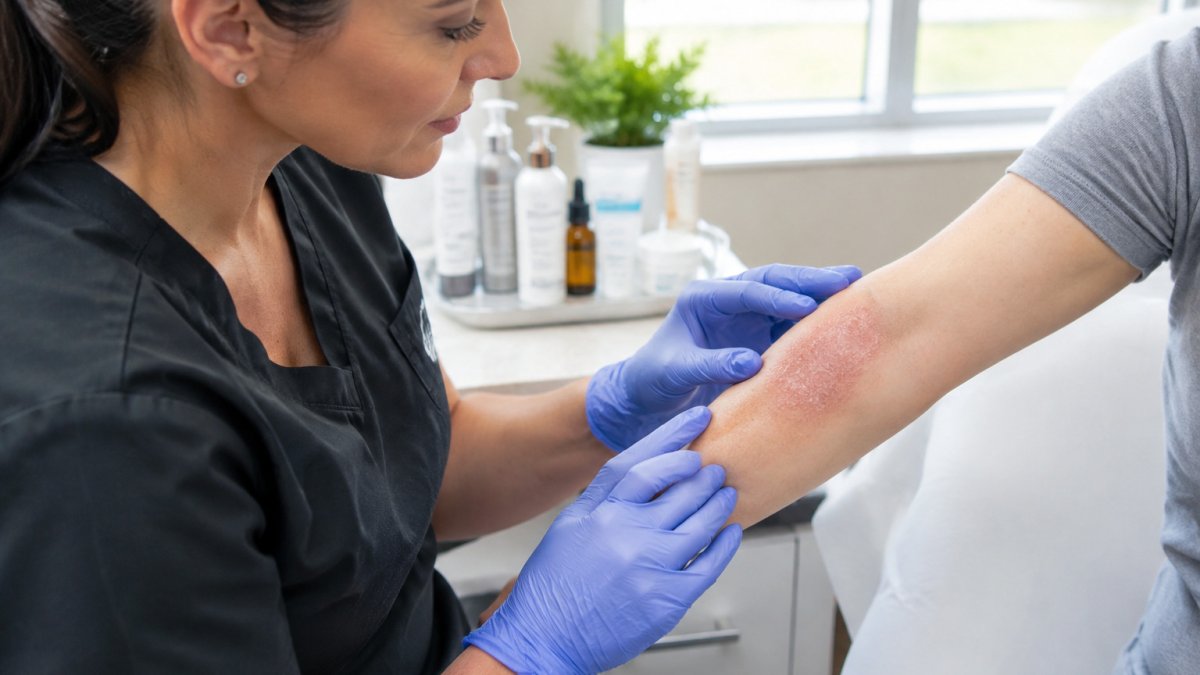
Looking closely at the pattern, edges, and texture of a rash gives useful clues, though not a final answer. For a broader comparison of rash types, see Understanding Different Types of Skin Rashes. In many cases, the shape of the lesion and how it changes over time matter more than its color. The table below summarizes the features most practitioners use to separate the two at first glance.
| Feature | Fungal infection | Bacterial infection |
|---|---|---|
| Border | Raised, scaly, sharply defined edge that expands outward | Poorly defined, spreading redness |
| Center | Often clears as the ring expands | Stays red, warm, and swollen |
| Surface | Flaky, sometimes powdery scale | Pus, crusting, honey-colored drainage, or blisters |
| Sensation | Itchy, sometimes burning | Painful, tender, warm to the touch |
| Speed | Spreads over days to weeks | Can worsen over hours to a day or two |
| Common sites | Feet, groin, scalp, trunk, skin folds | Legs, face, buttocks, sites of cuts or shaving |
Fungal Rash Patterns: Ring Shape and Central Clearing
Fungal infections often form a slightly raised, flaky border that expands outward, with the center starting to clear. This ring-like pattern is one of the more recognizable features, though it is not present in every case. Two familiar examples:
- Ringworm (tinea corporis): the classic annular patch with central clearing on the trunk, arms, or legs.
- Athlete's foot (tinea pedis): peeling and maceration between the toes, sometimes with a moccasin-like scale along the sole and heel.
A common pattern is that fungal patches itch more than they hurt, and they tend to grow slowly along the edge rather than uniformly across the whole area.
Bacterial Lesions: Pus, Warmth and Tenderness
Bacterial skin infections more often involve pus-filled bumps, crusting, warmth to the touch, and tenderness. The area may look swollen and feel painful rather than itchy. Staphylococcus and Streptococcus species account for the majority of bacterial skin infections in high school athletes, according to a National Center for Biotechnology Information review of common pathogens in athletic populations. Two familiar examples:
- Folliculitis: small, tender, pus-topped bumps centered on hair follicles, often after shaving or in a hot tub.
- Cellulitis: a spreading, warm, tender red patch with indistinct borders, usually on a lower leg.
- Impetigo: honey-colored crusts, most often around the nose and mouth in children.
Watch out: a rapidly expanding, hot, painful red area with fever is a cellulitis pattern that needs same-day medical evaluation, not a wait-and-see approach.
Where Visual Clues Fail
Appearance alone is unreliable in several situations. Early lesions of either type can look identical, and scratching or prior treatment with the wrong cream can blur the border and hide the original pattern. Darker skin tones can make redness harder to see, so warmth, swelling, and tenderness become more important than color. That is why dermatologists rely on clinical examination, skin scrapings, and cultures rather than sight alone.
Common Mimics That Fool the Eye
Several non-infectious conditions resemble fungal or bacterial infections. Eczema and psoriasis both cause red, scaly, or itchy patches, and they are frequently mistaken for ringworm. Nummular eczema, in particular, forms coin-shaped patches that mimic ringworm almost exactly. Contact dermatitis from a new soap, detergent, or jewelry can produce a red, weeping patch that looks bacterial. Because a steroid cream that calms eczema can worsen a fungal infection, an accurate identification matters before any treatment begins.
Signs of Bacterial Skin Infection to Watch For
Watch for spreading redness, increasing pain, warmth, drainage of pus, or a fever. Redness that expands quickly or streaks outward from the area warrants prompt medical attention. Signs of bacterial skin infection often develop faster than fungal ones, so changes over a day or two are worth noting.
Common Mimics: Eczema, Psoriasis and Other Look-Alikes
Several non-infectious conditions resemble fungal or bacterial infections. Eczema and psoriasis both cause red, scaly, or itchy patches, and they are frequently mistaken for ringworm. Because a steroid cream that calms eczema can worsen a fungal infection, an accurate identification matters before any treatment begins.
Why Using the Wrong Treatment Makes Things Worse
Applying an antifungal cream to a bacterial infection, or a steroid to a fungal patch, can delay healing and allow the problem to spread. Antibiotics do nothing against fungi, and antifungals do nothing against bacteria. Guessing wrong costs time, and in some cases it makes the infection harder to treat. Learn to spot warning signs of a skin reaction before it gets worse.
Book your appointment today! →
When to See a Dermatologist for Skin Rashes
See a dermatologist if a rash does not improve within a week or two, keeps returning, spreads, or does not respond to over-the-counter treatment. Seek care promptly if you notice fever, significant pain, or pus. People with diabetes or weakened immune systems should be evaluated sooner.
Red Flags That Need Same-Day Care
Some signs mean the infection may be spreading beyond the skin and should not wait for a routine appointment:
- Redness that expands quickly or streaks outward from the area
- Fever, chills, or feeling generally unwell
- Increasing pain out of proportion to what the skin looks like
- A hot, swollen, tender area that grows over hours
- Pus or foul-smelling drainage
- A rash near the eye or on the face in a child
Watch out: red streaks tracking up a limb with fever can signal a spreading bacterial infection that needs urgent medical attention.
How a Clinician Confirms the Diagnosis
Because appearance alone is unreliable, clinicians use a few simple tests to separate fungal from bacterial causes:
- Skin scraping with potassium hydroxide (KOH) preparation: looks for fungal elements under a microscope.
- Fungal culture: identifies the specific fungus when the scraping is inconclusive.
- Bacterial culture and sensitivity: identifies the organism and which antibiotic it responds to.
- Wood's lamp examination: uses ultraviolet light to highlight some fungal and bacterial patterns.
These tests are quick, inexpensive, and often decisive when the visual picture is ambiguous.
Children Versus Adults
Presentation differs by age. In children, impetigo and tinea capitis (scalp ringworm) are common, and scalp fungal infections often need oral treatment rather than a cream. In adults, athlete's foot, jock itch, and cellulitis on the lower legs are more frequent, especially in people with diabetes or poor circulation. A rash in a child that does not respond to an antifungal cream within a week deserves a professional look rather than a second round of the same product.
Home Care Versus Medical Intervention
Mild, localized fungal patches such as athlete's foot or a small ringworm spot often respond to over-the-counter antifungal creams when used for the full course on the label. Mild folliculitis may settle with warm compresses and better shaving habits. Prescription-strength treatment is generally needed when the infection covers a large area, involves the scalp or nails, keeps returning, or shows any red flag above. Antibiotics for bacterial infections require a prescription, and finishing the full course matters even after the skin looks better.
What to Expect at a Professional Skin Analysis
A professional skin analysis is not a substitute for a medical diagnosis, but it can help you understand your skin's barrier, hydration, and sensitivity before choosing a routine. Skin Solutions by 2 Divas in Sebring, FL 772-999-8820 can answer questions about what a consultation involves. If you are ready to get a professional look at your skin, you can book an appointment with Skin Solutions by 2 Divas or call 772-999-8820.
Corrective Facial Treatments for Skin Health: Where Professional Care Fits
Corrective facials address concerns such as acne, uneven tone, and visible sun damage. They are not a treatment for an active infection, which needs a medical diagnosis first. Once a skin condition has been identified and cleared by a physician, a professional skin analysis can help build a routine suited to your skin. Clients in Highlands County can learn more about corrective facial services in Sebring and surrounding areas.
Booking Your Skin Analysis in Sebring With Skin Solutions by 2 Divas
Skin Solutions by 2 Divas provides expert, custom corrective facials in Sebring, FL, designed to address individual skin concerns. If you are ready to get a professional look at your skin, you can book an appointment with Skin Solutions by 2 Divas or call 772-999-8820. Not every esthetician is equally qualified, so it is worth knowing what to check. Guidance on choosing a licensed skincare professional can help you compare options. For more on choosing the right provider, read how to find the best esthetician near Sebring, FL.
Skin Solutions by 2 Divas in Sebring, FL 772-999-8820 is available to answer questions about your skin.
Frequently Asked Questions
How do you tell if a skin infection is fungal or bacterial?
Fungal infections usually spread outward in a ring with a slightly raised, scaly edge and clearer skin in the center, and they often itch. Bacterial infections more often appear as red, warm, tender areas that may swell, ooze pus or form a crust, and they can spread quickly. Appearance alone is not reliable, because the two can look alike early on. A dermatologist can confirm the cause with a skin scraping, culture or biopsy, and that is the most dependable way to know which treatment you need.
What happens if you put antifungal cream on a bacterial infection?
Antifungal cream does not kill bacteria, so a bacterial infection will not clear with it alone. The area may seem to calm down briefly, which can delay the correct diagnosis and let the infection spread or deepen. Bacterial infections that involve pus, spreading redness, fever or significant pain usually need prescription treatment, such as an oral or topical antibiotic. If a rash has not improved after a short trial of any over-the-counter product, schedule an evaluation rather than switching products on your own.
Can a skin infection be both fungal and bacterial at the same time?
Yes. A fungal rash can become secondarily infected with bacteria after it is scratched or broken open, and that combination can look more inflamed and painful than either infection alone. This is one reason a rash that is getting worse despite treatment should be reassessed. A clinician may test for both organisms before choosing a treatment that covers each one.
When should you seek professional help for a persistent skin rash?
See a dermatologist or primary care provider if a rash lasts more than a couple of weeks despite over-the-counter care, spreads, keeps coming back, or is painful, warm, swollen or draining. Seek care promptly if you have a fever, red streaks spreading from the area, or a rash around the eyes, mouth or genitals. People with diabetes or weakened immune systems should be evaluated sooner. Skin Solutions by 2 Divas in Sebring, FL, offers professional skin analysis, but a rash that may be infected should be evaluated by a medical provider first. Call 772-999-8820 to ask about booking a skin analysis.