 blog
How Long to Fix Skin Texture: A Timeline by Treatment
Table of Contents
- What Causes Uneven Skin Texture and Why Timeline Matters
- How Long to Fix Skin Texture at Home: Realistic Expectations
- Best Products for Skin Texture: Budget-Friendly vs. Clinical-Grade
- How Long Does It Take to See Results From Skincare Products
- Professional Treatments: How Long to Fix Skin Texture Faster
- Sun Protection and Long-Term Skin Health
- Conclusion: Your Personalized Skin Texture Timeline
- Frequently Asked Questions
How Long to Fix Skin Texture: A Timeline by Treatment
Last Updated: July 29, 2026
Wondering how long to fix skin texture is one of the most common questions we hear from people frustrated with bumpy, uneven, or rough skin. The honest answer: it depends on what's causing the texture issues, your skin type, and whether you're using at-home treatments or professional interventions. At SKIN SOLUTIONS BY 2 DIVAS, we've worked with hundreds of clients to transform their skin texture. Below, we'll walk you through realistic expectations for both DIY skincare routines and clinical treatments.
What Causes Uneven Skin Texture and Why Timeline Matters
Understanding what's driving your skin texture problems is the first step to knowing how long to fix skin texture effectively.
Common Culprits Behind Bumpy, Rough Skin
Uneven skin texture typically stems from dead skin cell buildup, reduced collagen production, sun damage, and pore congestion from excess sebum or product residue. When dead cells accumulate, they create a dull, bumpy appearance, which is why exfoliation plays a central role in texture correction.
Pore congestion is another major driver. When sebum, bacteria, and dead cells get trapped in pores, they create visible bumps and uneven surface clarity. Sun damage breaks down collagen and elasticity, leading to rougher skin over time. Dehydration is often overlooked but critical, when your skin barrier is compromised, cells don't shed smoothly, and the surface becomes rough and dull.
Why Your Skin Type Affects How Quickly You'll See Results
Your baseline skin type determines both how quickly texture improves and how you'll respond to treatments. Oily skin tends to show faster surface improvements but is more prone to congestion when you introduce active ingredients. Dry skin may improve more slowly on the surface but often responds better to hydration-focused approaches long-term. Sensitive skin requires the most cautious approach, extending the timeline by weeks as you introduce exfoliants and actives slowly.
Age also matters. Younger skin with intact collagen production may see textural improvements in 4-6 weeks with consistent exfoliation. Mature skin, where collagen has already declined, typically needs 8-12 weeks or longer and may benefit from professional treatments to accelerate deeper dermal changes.
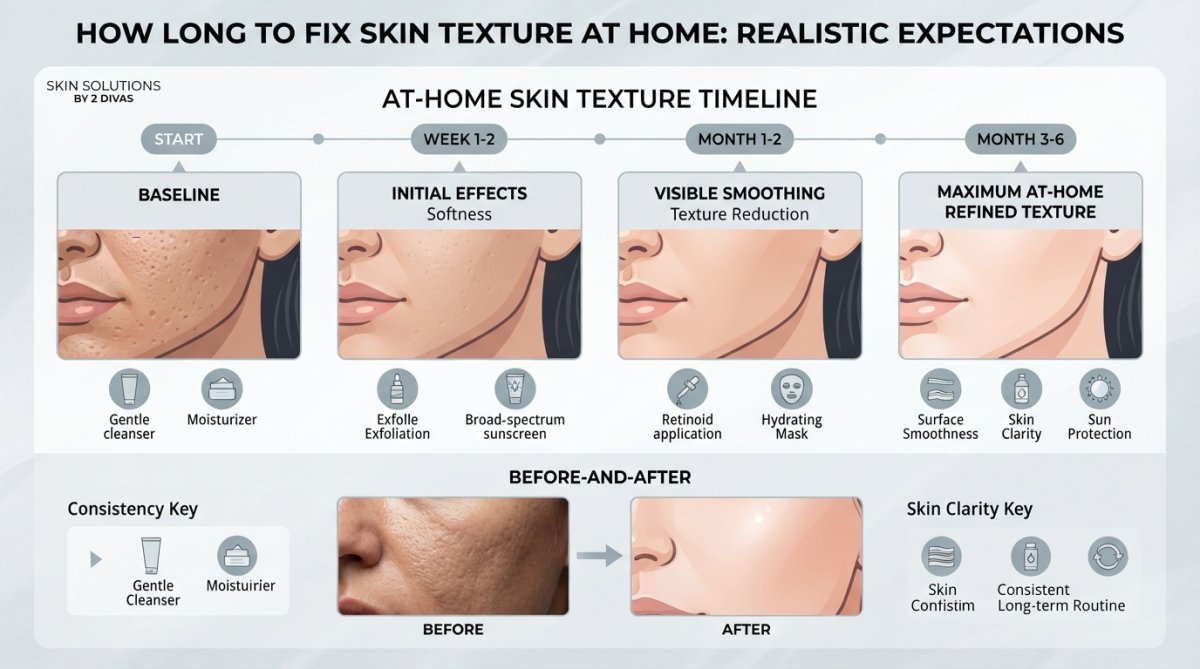
How Long to Fix Skin Texture at Home: Realistic Expectations
Most people want to know how long to fix skin texture without professional treatments. At-home care can deliver significant improvements, but the timeline is longer than many expect.
Weeks 1-4: The Adjustment Phase and Purging vs. Reaction
When you introduce exfoliating acids (AHAs or BHAs) or retinoids, your skin enters an adjustment phase. During weeks 1-4, expect your skin to look slightly worse before it gets better.
Purging occurs when exfoliants or retinoids accelerate cell turnover, bringing congestion that was already under the skin's surface to the top. You'll see small bumps or whiteheads emerge temporarily, this is a sign the product is working. A reaction, by contrast, is genuine irritation: redness, burning, or sensitivity that feels uncomfortable. Reactions mean you need to reduce frequency or switch products.
During this phase, your skin barrier may feel compromised. This is why hydration matters enormously. Even if you have oily skin, you need a lightweight moisturizer to support your barrier while active ingredients do their work. By week 4, purging typically subsides, and the adjustment phase is ending.
Weeks 5-12: Visible Surface Clarity Emerges
Between weeks 5 and 12, consistent exfoliation with AHAs or BHAs, combined with a solid moisturizer and sun protection, produces noticeable surface clarity. Pores appear smaller, the skin looks brighter, and that dull, bumpy texture smooths out.
Retinoids accelerate this phase significantly. By week 8-12 of consistent retinoid use (assuming you've titrated up properly), many people report that their skin texture feels noticeably smoother and looks more refined. The key variable is consistency. Using a chemical exfoliant twice a week for 12 weeks will deliver better results than using it daily for 4 weeks and then stopping.
Months 4-6: Deeper Dermal Changes and Cell Turnover
After three months of consistent treatment, you're triggering genuine dermal changes. Retinoids and chemical exfoliation stimulate collagen production and improve skin elasticity. By month 6, if you've been consistent with exfoliation, retinoids, hydration, and sun protection, you'll see substantial improvements in skin texture.
However, these improvements only stick if you maintain your routine. Texture issues tend to return within 4-8 weeks of stopping active treatment.
| Timeline | What to Expect | Key Actions | Success Rate |
|---|---|---|---|
| Weeks 1-4 | Purging, adjustment, possible congestion | Introduce actives slowly, prioritize hydration | 60% stay consistent |
| Weeks 5-12 | Surface clarity, pore refinement, visible smoothness | Maintain exfoliation 2x/week, add retinoid | 75% see noticeable results |
| Months 4-6 | Collagen stimulation, elasticity improvement, durable texture change | Continue routine, assess for professional treatment | 85% satisfied with progress |
| Months 6+ | Maintenance phase, sustained improvement | Reduce frequency slightly, focus on barrier health | 70% maintain results |
Best Products for Skin Texture: Budget-Friendly vs. Clinical-Grade
The product category you choose affects both timeline and results.
Chemical Exfoliation: AHAs, BHAs, and Ingredient Interactions
Chemical exfoliation is the fastest, most reliable way to improve skin texture at home. Glycolic acid (an AHA) dissolves the bonds between dead skin cells on the surface and works best for dehydrated, sun-damaged, or dull skin. Salicylic acid (a BHA) is lipid-soluble and penetrates into pores, making it ideal for congested, oily, or acne-prone skin.
Budget-friendly options (5-10% glycolic acid or 2% salicylic acid) work but require consistent use for 8-12 weeks to see results. Clinical-grade products (15%+ glycolic acid) work faster, often 4-8 weeks, but carry higher risk of irritation.
A critical mistake is combining incompatible ingredients. Using a BHA with a vitamin C serum on the same night, or layering multiple exfoliants, damages your skin barrier and slows texture improvement. The rule: one active per routine.
Retinoids and Collagen Production: The Long Game
Retinoids are the gold standard for stimulating collagen production and improving skin elasticity. Over-the-counter retinol takes 8-12 weeks to show meaningful texture improvements. Prescription retinoids (tretinoin, adapalene) work faster, 4-8 weeks, but require dermatologist supervision.
Combining a mild chemical exfoliant (once or twice weekly) with a retinoid is the most effective at-home approach for texture, but you must introduce them sequentially, not simultaneously. Start with the retinoid, establish tolerance over 4-6 weeks, then add the exfoliant.
Hydration and the Skin Barrier: Why Moisturizer Matters
A compromised skin barrier slows cell turnover, increases sensitivity, and can worsen texture by causing inflammation and congestion. A strong barrier, supported by a good moisturizer, allows active ingredients to work effectively without triggering excessive irritation.
Budget-friendly moisturizers with ceramides, hyaluronic acid, and glycerin work well for supporting the barrier during active treatment. For texture correction, the moisturizer should be your second-largest product expense after your exfoliant or retinoid.
How Long Does It Take to See Results From Skincare Products
Your skin's natural cell cycle is approximately 28 days, the time it takes for a cell to form in the basal layer, migrate to the surface, and shed. This is why dermatologists consistently recommend waiting at least 4-6 weeks before assessing whether a new skincare routine is working.
The Science of Skin Cell Turnover and Surface Renewal
When you apply an exfoliant or retinoid, you're accelerating a process that's already happening. Chemical exfoliants speed up the shedding of dead cells. Retinoids increase the rate at which new cells form and migrate upward. Both work with your skin's natural timeline, not against it.
This is why how long to fix skin texture can't be rushed. By week 4, you'll see the first real changes. By week 8, the changes are substantial. By week 12, they're often dramatic. Skin with severe sun damage or significant hyperpigmentation may need 16-20 weeks of consistent treatment.
Common Mistakes That Slow Down Results
The most common mistake is inconsistency. Using a product three times one week, then skipping it the next week, means your skin never completes a full adaptation cycle.
Another major mistake is introducing too many products at once. If you start a retinoid, a chemical exfoliant, a vitamin C serum, and a new moisturizer simultaneously, you won't know which product is helping or hurting, and your skin barrier can't handle that much change.
Over-exfoliation is surprisingly common. Using an exfoliant more than 3-4 times per week damages your barrier and causes inflammation that worsens texture. Finally, skipping sun protection undermines everything else. UV damage breaks down collagen and elasticity, creating new texture issues while you're trying to fix existing ones.
Professional Treatments: How Long to Fix Skin Texture Faster
If at-home care isn't delivering results fast enough, professional treatments can accelerate improvement significantly.
Chemical Peels and Laser Resurfacing: Timeline and Expectations
Professional chemical peels use much higher concentrations of exfoliating acids than at-home products. Most people see noticeable texture improvement after just one peel, with optimal results after 3-6 peels spaced 2-4 weeks apart. Total timeline: 6-12 weeks, versus 12-16 weeks for at-home care alone. Recovery is real, deeper peels cause redness, peeling, and sensitivity for 5-7 days.
Laser resurfacing (fractional CO2 or erbium lasers) targets texture, pores, and collagen production simultaneously. Most people see 40-50% improvement after one session, with optimal results after 2-3 sessions spaced 4-6 weeks apart. Total timeline: 8-16 weeks. Recovery is longer (7-14 days of visible redness and peeling) and the cost is significantly higher.
Both treatments stimulate collagen production, so improvements continue for 3-6 months after your final session.
Microdermabrasion and Custom Corrective Facials
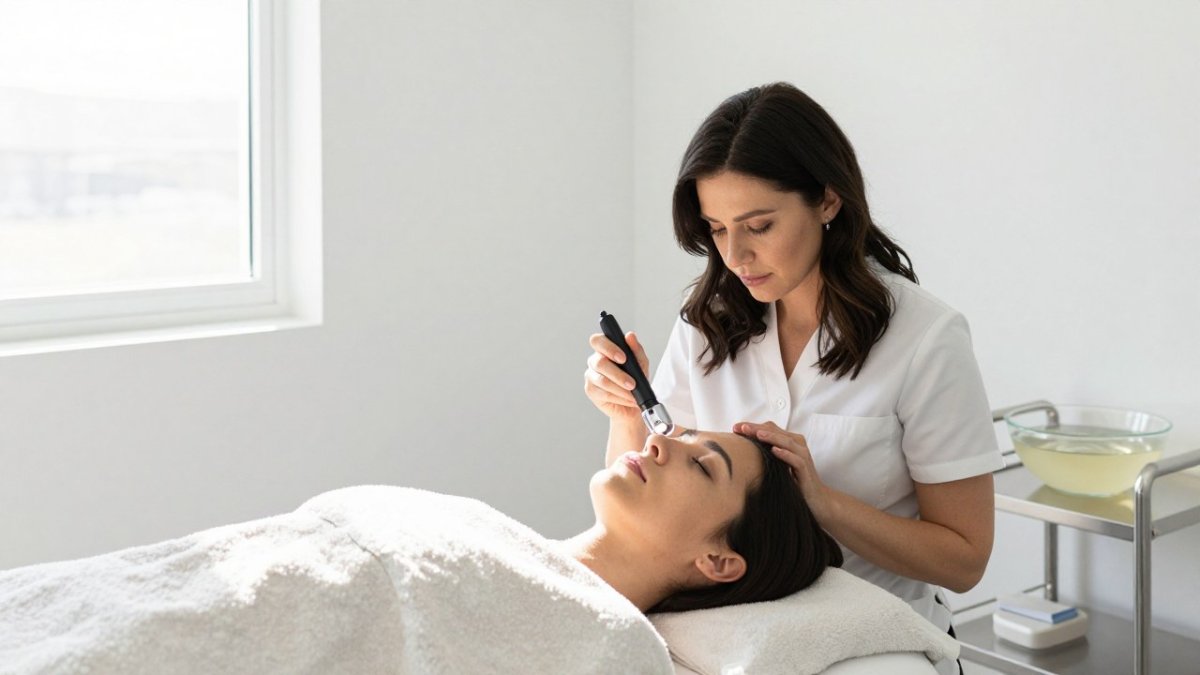
Microdermabrasion uses tiny crystals or a diamond-tipped wand to physically exfoliate the skin. It's gentler than chemical peels and laser treatments, with minimal downtime. Results are more modest, typically 15-25% improvement per session, so you need 4-6 sessions spaced 1-2 weeks apart. Timeline: 6-12 weeks for noticeable results.
Custom corrective facials, like those provided by SKIN SOLUTIONS BY 2 DIVAS, combine exfoliation, extraction, hydration, and targeted serums based on your specific skin analysis. These facials accelerate at-home results by 2-4 weeks when done monthly. Most people see visible improvement after one session, with cumulative improvements over 4-6 sessions.
Combining Professional Care with At-Home Maintenance
The most effective approach combines professional treatment with at-home care. Professional treatments provide the initial acceleration. At-home care maintains and extends those results.
A realistic timeline for combined care: Month 1, get a professional chemical peel or corrective facial. Weeks 2-4, use gentle at-home exfoliation and retinoid to support healing and build on results. Month 2, repeat the professional treatment. By month 3, you've made 8-12 weeks of progress in 12 weeks of calendar time, versus 16 weeks with at-home care alone.
Sun Protection and Long-Term Skin Health
Sun protection is the most underrated part of texture improvement. UV damage breaks down collagen and elasticity, creating new texture issues while you're treating existing ones. Without sun protection, texture improvements don't last.
People who complete a 12-week texture-correction routine but skip sunscreen often see their improvements fade within 8-12 weeks. People who use SPF 30+ daily maintain their improvements for months or years. A broad-spectrum SPF 30 should be part of your routine every single day, even on cloudy days and even if you're staying indoors.
Conclusion: Your Personalized Skin Texture Timeline
How long to fix skin texture depends on your starting point, skin type, and treatment approach. At-home care with consistent exfoliation and retinoids typically delivers noticeable results in 8-12 weeks, with optimal results by month 6. Professional treatments accelerate this timeline to 4-8 weeks, but require higher investment and recovery time.
The real timeline isn't measured in weeks, it's measured in consistency. One person might see dramatic texture improvement in 8 weeks because they're rigorous about their routine. Another person might need 16 weeks because they're inconsistent.
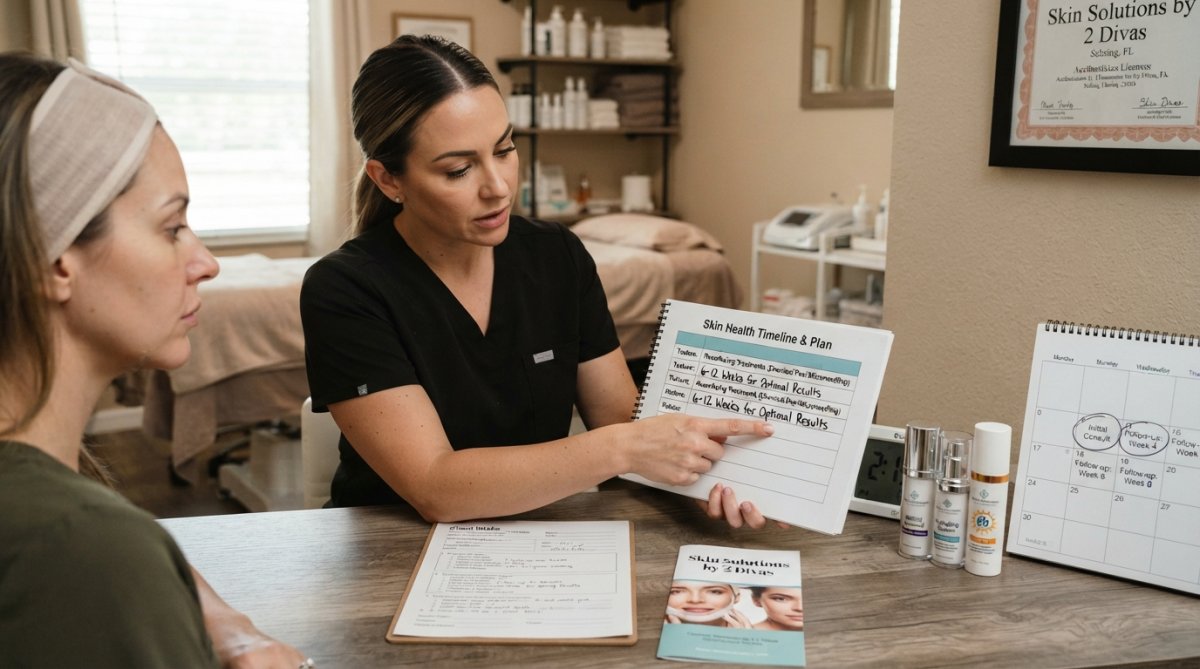
If texture issues are affecting your confidence, professional guidance makes a real difference. SKIN SOLUTIONS BY 2 DIVAS provides custom corrective facials designed specifically for texture concerns, combining thorough skin analysis with professional-grade exfoliants and targeted actives. Our specialists create personalized treatment plans that address your unique texture issues, whether they're from congestion, sun damage, or aging, and show you exactly how to maintain results at home. Book your appointment today and discover how professional care, combined with the right at-home routine, can transform your skin texture in weeks, not months.
Frequently Asked Questions
What causes uneven skin texture and bumpy skin?
Uneven skin texture results from several factors: dead skin cell buildup, reduced collagen production, dehydration, sun damage, acne scarring, and pore congestion. Hormonal changes, genetics, and inconsistent skincare routines also contribute. The root cause determines your treatment timeline, surface texture from dead cells improves faster than deep dermal damage from sun exposure or scarring.
How long does it take to see results from skincare products for texture?
Most people notice surface clarity improvements within 4-6 weeks of consistent exfoliation and hydration. Chemical exfoliants like AHAs and BHAs work on the outer skin layers and show faster results. Retinoids, which boost collagen production and cell turnover, typically require 8-12 weeks for visible texture refinement. Results depend on product strength, skin type, and adherence to routine.
What's the difference between 'purging' and a reaction when treating skin texture?
Purging is a temporary increase in breakouts (1-4 weeks) when exfoliants or retinoids accelerate cell turnover and bring congestion to the surface, a sign the product is working. A reaction is persistent redness, irritation, or worsening texture that doesn't improve, signaling the product is incompatible. If purging occurs, continue the routine; if a reaction persists beyond 2 weeks, discontinue and consult a dermatologist.
Can professional treatments like facials or chemical peels fix skin texture faster?
Yes. Professional treatments like custom corrective facials, chemical peels, and laser resurfacing can accelerate results significantly. A single professional-grade chemical peel may deliver 4-8 weeks of at-home results in one session. However, lasting improvement typically requires a series of treatments (3-6 sessions spaced 2-4 weeks apart) combined with a consistent at-home skincare routine for sustained skin elasticity and smooth texture.
This article was written using GrandRanker